Thursday, April 10, 2008

Working with Rural Women in Jamaica

I have now been here for more than 10 days and my assignment is coming to a close as I head towards Montego Bay to spend a week with friends. Oh! what a stay! I will try to add pictures to this blog to help you visualize my travels.

First I had a 15 hour flight schedule to get through. Leaving at 6:30 am from the little airport near me on to Boston then Miami then Kingston, Jamaica. I spent a few days in Kingston getting an orientation of sorts from Mildred, the Jamaica Network of Rural Women Producers' president who has been my counterpart for the duration of my stay. Mildred is a vivacious local women who doesn't let any grass grow under her feet as she tries to attend to the need of her 300 members all over the country.
She started me out easy with a 2-day orientation in Kingston and meetings with founders and supporters of the JNRWP, who explain the plight of the Rural Women. They lack support, discretionary funds, access to credit, self esteem, health care, Included in my orientation is a visit to the Jamaica Agricultural Society’s (RADA) products store. The store is an outlet for small producers making value-added ag products. It was easy to see that a lot of help will be needed here with their labeling practices. There are great products; Mango or Guava Syrup for pancakes, coconut candies, nuts, jams, jellies like Sorrel jelly, and more... Many have not been able to resist putting the name of their company in big bold letters while the other information such as the product or the package content disappears into the background. “Just what is in there?” I ask, and the clerk is happy to tell me but she doesn’t get that a stranger to these products, will have trouble immediately identifying what the product is. “It’s Ground Cinnamon, can’t you see it’s written on the label.” “No I don’t but I see--- there is blue lettering here just about the same color as the blue background.”


The rest of my week is taken up with visits into what my host, Mildred C. calls the “Deep Rural” to the Top Mountain Juice Factory near Kitson Town and to Ebony Park Agricultural Academy. The Top Mountain Juice Ltd is producing “suck-suck” which are little individual juice plastic packets that are frozen and sold to school children. They are made into various flavors: orange, cherry, papaya juice etc… and sold to street vendors and retail establishments near schools. This is a community based project that has had the good luck to catch the Embassy of Japan’s attention. They have been given more than $88,000 USD by Japan to build a state-of-the-art juice-making plant which includes a new building complete with equipment. The group has been operating for 4 months and they can sell all they can produce keeping the 6 women and two men busy and employed, although they do not make enough yet to pay themselves. They plan to graduate soon from making the juice from flavoring to using the Top Mountain community’s local fruits to make better juices and in larger containers. A discussion with the employees about marketing and business management reveals that none are comfortable with the non-production side of their business. They have a space for the business office that includes an empty desk but haven’t set up their books, files or inventory management and do not know how to even begin setting up the business side of the production plant. They also need to develop a Business Plan for the new company. They would like to have a business manager but can’t afford one. I promise to contact the US Peace Corp office in Kingston and see about getting them someone assigned to them, for Business Development, from the new crop of Peace Corp volunteers that have just arrived for their two-year assignment in Jamaica.


This assignment is followed by another with the Ebony Park Agricultural Training Centre in Clarendon. This is a vocational school for High School age students learning hospitality trades, agriculture and food processing. I was invited to give a lecture on Marketing, Packaging and Labelling to the Agro-Processing students as well as a dozen local food producers. The Training Centre has a brand new Agro Processing Lab where they research, develop, and package new value-added products from Jamaican fruits and vegetables. The food producers and myself, were treated to a tour of the facility. Here, the students and faculty produce juices, jams, jelly, new types of spices, condiments, syrups. We got to taste a newly developed Pumpkin Syrup which is spectacular. I was asked to evaluate their labels and packaging by Mr Shaw, the Training Centre Director. Currently they sell only to an “internal market”-- mostly faculty, students, friends of the school, but hope to expand their market more broadly. The labels are picturesque and elaborate---perhaps too elaborate--and Ebony Park will want to redesign, simplify and integrate these under one recognizable label, if they wish to brand their products under the “Ebony Park Pride” label and reach out to outside markets. I was introduced to the processing of ground pepper from the waste of processed peppers. Below is the waste after drying then the grinding and packaging. The


two Agro-Processing professors, Lynch and Williams, are very advanced in their field, helping lead students towards employment by the Jamaica food manufacturing sector. Lynch is the former Director of the Jamaica Scientific Research Council, an organization that support the growth and development of the agro-industrial sector in Jamaica, and worked as a food scientist in the US for many years in work associated with Cornell University. It is my hope that students from US Universities will want to come here as volunteers, grad assistants or exchange students, where all will share mutually in their development.

Another memorable rural development experience has been my 3-day stay amongst the Mango Valley women. Mango Valley is in the Parrish of St Mary in a very pretty small village called Oracabessa, nestled in the mountains near the sea. During my time in Mango Valley, I conducted workshops for their community-based Training Center (another vocational school) -- for training in hospitality, home economics, entrepreneurship, and spent another day with a group of women ag producers that will produce food in the School’s agro-processing Center (currently under construction.)


The women are making value-added products such as banana flour, breadfruit flour, grounded kola nut, apple sauce, jerk seasoning, guava cheese, various jams, jellies, etc… A review of their labels showed consistency and simplicity in appearance with a good brand name “Mango Valley Pride” as well as good identification of the product. Only minor adjustments were needed in identifying ingredients and nutrition facts. The women received a rush order for Guava Cheese while I was there and they treated me to a demonstration of the making of their cheese. The cheese is sweet and guava is boiled and cooked to the consistency of our American fudge


products and it is spread and cut in squares much like fudge. Unfortunately, it was never finished while I was there and never got to taste it. Perhaps I will before I leave
here. Most endearing in my stay with the Mango Valley women was experiencing their boisterous devil-may-care attitude about life and the happy way most of them approach life. They love to laugh and dance and make merry.


Next, I will write about some of the farms and places where I am spend some of my leisure time while in Jamaica.

Thursday, December 07, 2006

Kabul--such a lovely place....

My time in Kabul is now over and I am heading back home. Its been an amazing time.... Making an analysis of Afghanistan's vegetable sector and trying to find information that will help better understand the supply and value chains. Afghanistan has great vegetables and just about everything can be grown here because of the varied climate --amazing for a country with only 12% arable land. But there is enough vegetable that some are exported during the Harvest season... then gets imported back into the country from Pakistan during the off -season. Many say that Pakistan which has storage facilities simply provides storage then sends it back. Selling vegetables when the price is low and buying back when the price is at premium is a problem that needs to be solved in Afghanistan. It started to snow during my last two weeks in the country and even a little snow caused havock. You can see some of it here on the right at my hotel--the Park Palace. There were still roses blooming but we had several days of snow. It turned the unpaved street to mud. I visited the wholesale vegetable market and there was mud to midcalf from some of the traders. It also caused the airport to shut down for a few days and many flights cancelled. I wondered if I would leave on my departure date-- but luckily the sun shone on Dec. 5 and I made it to Dubai.

In spite of mud and snow, my time in Kabul whizzed by and many activities filled my evenings and days off, thanks to great friends at the hotel who saw to it that I wasn't bored. There were several wild nights listening to our hotel band (a few of the hotel guest have hidden talents as rock musicians and play at local restaurants...) and drinking--because it the sale of liquor is prohibited here by the Minister of Vice and Virtue. We had a family thanksgiving dinner cooked by Jim and Tim--a mining engineer and ag extensionist who turned out to be star cooks and gave us turkey and trimmings including all the traditional side dishes. We also had many Friday excursions to the craft markets as we dumped some of our earning on Afghanistan for beautiful scarves, shawls, and local stone jewelry. And then there were the carpets... I am now trying to make my way home with too many and very heavy luggage I can hardly handle.

And there were the wonderful Afghan people. Those who are trying to make their home country better in whatever way they can. They are unforgettable. And the beautiful children who are playful and trusting and want to make contact with the foreigners who have invaded their homeland. They like to have their picture taken if their parents or guardians let them. On these rare occasions your just seize the moment as these opportunities don't come along often.
In all its been an unforgetable five weeks here. And even if I had to spend 7 hours standing up waiting for my boarding pass at the Kabul airport because a few snowy days caused some cancelled flights, I will soon forget the mess that is Kabul and remember only the good days when things worked right and people showed faith that you would make a difference.

Sunday, November 12, 2006

Back in Afghanistan


Well here I am again at the Park Palace Guest House and on temporary assignment in Kabul. It is cooler now than during my last trip which was in August 2004 but it still warms up in the afternoon to a nice sunny 60-65 degrees. However, Winter must be coming-- it has started to rain over the past few days and this morning I spotted snow on the Hindu Kush mountains, the very high mountain range that crosses Afghanistan from East to West, just North of here. I haven't found it too cold yet even as our rooms are barely heated. But winter, I am told, gets cold enough and I will likely experience it while here.

Kabul is still the same. It is less of a shock the second time around. The city is still a messy and dusty city with retail tents everywhere along the streets. There are no traffic regulations just an occasional policeman who directs traffic at rotaries...(There are no traffic lights and no lines on the road defining lanes etc...) During morning rush traffic, cars manage to merge together, get through intersections, and get across the city with relatively few accidents. I sometimes cringe when I see my driver move into the lane of oncoming traffic to get around some cars. A few days ago I saw the city's first traffic light had been installed near my hotel. My driver ignored it and just drove through the red light. We are betting that the traffic light will cause more accidents than before. The main streets are paved but all the side streets are dirt roads. By 5 pm, that dust mingles with exhaust from the cars and is hanging thick in the air. Sometimes the dust and smoke overcome us ans we start caughing. There is a good reason for men and women to wear scarves here and to cover our mouth with them. Now that the rains have started, the dust has been replaced by pools of water and mud on all the side streets. But that is a minor inconvenience--- the streets are also full of wonderful scenes of the Afghan people getting on with their daily life and engaging in work or shopping activities. All businesses and shops also have signs in english as well as Dari and Pashtu. It is a sign that they like us here and want to welcome us into their shops. A young afghan man riding in the car with me this morning, said that when the Russians were in Afghanistan, no shop owner or businesses has signs in Russian because they did not want them here. I get picked up and travel every morning to CNFA where I work. This office is in a beautiful house (see picture on the left...)where the country director and the deputy directors live. Even at this time of year, there are roses surrounding a green lawn. Decking is made of several types of marble....Because of the amount of dust constantly in the air, windows are washed every few days.

My weeks here are looking like they will be full of events. There is a nice cameraderie between guests and international workers here at the hotel and a small social life. Many are getting together for dining or shopping excursions and whenever there is an excuse, there is a party. We plan to celebrate Thanksgiving by cooking ourselves a traditional Turkey dinner. Am looking forward to it. I also hope to have a few more shopping excursions to the International Forces (ISAF) compound where we can do some craft shopping. On Fridays, they bring in a whole bunch of Merchants... rug merchants , gemstone merchants, and lots of crafts people, there must have been 40+ retail tents set up there last week.. I bought a bunch of jade and lapis lazuli necklaces (for gifts). Afghanistan has a lot of precious, semi precious stones -- they are one of the sources for Lapis and they have lots of other nice stuff too like tourmaline and rubies. They also have the most beautiful carpets I have ever seen.

In my next blog , I will describe how we "foreigners" spend our free time in Kabul.

Thursday, July 27, 2006

Lasting Memories in Haiti

I have now been back home in Vermont about 10 days . It has given me a chance to sort out pictures and things I learned while on my last trip. Haiti’s slave population gained freedom via a revolt in the early 1800’s, a good 65 years before the U.S. abolished slavery. Toussaint L’Ouverture, shown in this picture here, is the courageous slave credited with sparking the revolution that freed 30,000 slaves from the French. Throughout its 200 year independence, the country’s economy has been battered with frequent political upheavals and coups. Because of the violence and kidnappings that too often occur here, the numbers of international workers have been limited. One often finds missionaries and the religious orders that have been here for decades. There are also some courageous volunteers from many countries who come here in spite of Haiti’s instability, that come for the simple reason that they want to help. I was so impressed to meet a group of young men from Canada who are here to help the street kids in the northern region. There are many boys age 8 through 15 throughout the country who are sleeping and living on the streets. The volunteers want to provide intervention by teaching them how to start enterprises or gain skills before they become involved in crime.


Benito, my sponsor and Haitian program manager and his colleagues in the Mackage Agro Entreprise Association (pictured on the left.) have been working with those volunteers helping the street kids start rabit-raising or beekeeping enterprises and learn alternatives livelihoods and means of support. They also help provide food to the orphanages and have helped landscape the public parc shown in this picture. This is only a small pebble in a huge ocean of work that is badly needed here but its wonderful that these efforts are taking place.


The open air Marketplace in Cap-Haitien stretched for blocks. It was amazing to be able to watch all its activity from the 2nd floor office of Makage. In spite of rampant poverty and lack of employment, buying and selling is very active. I hope to return some day to see the positive changes that will undoubtedly take place in years to come.

In Haiti, the streets burst with activity and people


Haiti is the poorest nation in the western Hemisphere. 80% of its population lives in extreme poverty. The average life expectancy is 53 years old and unemployment is estimated to be at 50-70%. They tell me here that typical Haitians often skip 1 or 2 meals each day because there is not enough to eat. Most of the Haitians I have met seem to skip lunch regularly and just wait until Dinner to eat. Their stomach has shrunk to accommodate their ability to eat.

Sixty six percent (66%) of Haitians make a living through agriculture. But it is very difficult for food producers to get their products from their garden or farm to market because the roads are very bad. A typical vehicle will not last 3 years on such roads and the associations are the only means of joining together to eliminate some of the barriers in the Marketplace.

While in Cap-Haitien, I met a not-so-typical agricultural producer. Accene Augustin is a beekeeper who is also involved in growing fruit products, raising rabbits (elevage de lapin,) chicken, goat meat and more…. He is from the Grande Riviere about 26 km from Cap-Haitien, which takes 1.5 hours to reach the Cap on a good day. He has to bring his products to Cap-Haitien each week when in season. He is very active in the promotion of the Ag and Natural Resouces sector and Accene is the representative for the North to Association Nationale des Transformateur de Fruits (ANATRAF)… He was one of the founders of MAKAGE where he represents his commune (a commune is a district in his region.) He reports that the people of his commune have projects for preserving some fruits or drying. They make syrups and liquors from some of the fruits and honey. “Pladeg” is the name of the liquor or syrup/sugar that is made locally and MAKAGE sells it. There is a lot of outside competition for products from exterior markets such as the Dominican Republic which sends dozens of trucks filled to the rim each day. These mass-produced produce and staples most often are sold at lower prices and have better, more acceptance from the public. The cost in Haiti for sugar, energie etc.. is very costly and homemade Haitian goods cannot compete. Posted by Picasa

Monday, July 10, 2006

Haiti-A jewel in the Rough


Haiti has been good to the US... Here is an article that was sent to me by a friend while I've been in Cap-Hatien:

APRIL 19, 1802: Mosquitos Win the West ......Events that change America don't always occur within our borders. Consider the spring of 1802. Napoleon had sent a formidable army under his brother-in-law, General Charles Leclerc, to quell the rebellion of former slaves in Haiti.

On April 19, Leclerc reported to Napoleon that the rainy season had arrived, and his troops were falling ill. By the end of the year, almost the whole French force, including Leclerc himself, were dead of mosquito-borne yellow fever.
When Napoleon realized his reconquest had failed, he abandoned hopes of a
New World empire, and decided to sell the Louisiana Territory to the United States.

"Across a huge section of the American heartland, from New Orleans up through Montana, they ought to build statues to Toussaint L'Ouverture and the other heroes of the Haitian Revolution," says Ted Widmer, director of the John Carter Brown Library at Brown University."

Since being in Haiti, I have been busily engaged in training people at the Makouti Agro Entreprises also known as MAKAGE. It is a cooperative made up of members who produce vegetables, honey meat and crafts for marketing in the area of Cap-Haitian. First it was a one-day training on creating business and marketing plans then followed by individual sessions about creating Cashflow projections. Some are beekeeper enterprises associations that are busily trying to encourage households/farmer in Haiti to join the ranks of beekeeping--- an activity that lends itself rather well to this country. After several years of investment in Agriculture here, there are some 14,000 + beekeepers and growing. The problem, they cannot afford the hives or the material to make them so some are forming associations to try to raise monies, grants, or whatever will help these farmers manage.

Sunday, July 02, 2006

Life in Cap-Haitien


The biggest event here in Haiti this week was the World Soccer Tournament. Many men from the village gathered in the TV room to view this big event. Of course , you would expect that everyone was rooting for France here in Haiti since everyone speaks French or Creole. Most want Brazil to win and were disappointed at France's win on Saturday.


I live and often work at the Hotel du Roi Christophe, an inn that reminds me of many old movies and of Bogey and Becall in Casablanca. The hotel is a 200 year old structure built as a Spanish Colonial House with verandas, endless rows of arches and inner courtyards and gardens. The Roi (King) Christophe is one of the original slaves of this place which was the Plantation owners' house. Christophe contributed to a revolt which freed the slaves and established Haiti as an independant state several hundred years ago. The owner of the hotel has very good taste in Haitian Art which can be found throughout the hotel. I have good food, nice surroundings at the hotel and sleep very well. There are air-conditioned rooms here but I have one with just a fan and it is fine. There are a handful of other US humanitarian workers here—I’ve met several health workers from Maine working on Health related programs, and one girl from Quebec who is a professor from the Univ. of Sherbrook (she is the one sitting in the rocking chair…) and is here training the high school teachers on curriculum development. Everybody I have met so far can speak French like I do.
This is the Hotel lobby on the right....
Communications here is a challenge. Cell phones work in Cap-Haitien but are terrible when communicating with Port-au-Prince and elsewhere. Internet is an iffy thing even when we have wireless. As if these people don't have enough to deal with.....It always seems that in countries where people are the most oppressed, or face extreme development challenges, that their means of communicating with each other and the rest of the world is all broken up-- but things are getting better here and you can see the hope in the people of this area (better than Port au Prince.) They are setting up their enterprises and farms and producing and planning for the future and people like Benito are extremely dedicated to helping their people and hopeful the country’s future is improving and people will be able to make more money and feed their families. There is wonderful potential for tourism here but the country has a long way to go to improve security for its travelers. But cruise ships do come by and stop for a day in limited places. The opportunities for picture taking are endless and I know I will have hundreds of beautiful pictures of street life when I return. Posted by Picasa

En Haiti, enfin!

Here I am in Haiti and in a beautiful tropical environment. I should be ecstatic to have returned to the Caribbean once again but this time I am not a tourist as there are very few here and this is not a land that caters to tourist. I am among a handful of volunteers who come to Haiti to help out in whatever way they can. The picture of me shows where I am found on most days –at the hotel busily preparing my training and where I have access to wireless internet.

The temperature is in the 90’s here and very humid, giving it a heat index above 95. It seems like an inescapable heat! Looking or hoping for a breeze in early July is a lost cause. In Haiti, electricity is intermittent. Air conditioners are practically non existent and during these times of high energy prices (gas is over $5/gal,) AC’s and luxuries of that kind are not possibility for most people. Luckily, my hotel, L’hotel du Roi Christophe has a large generator providing us 24 hour electricity.

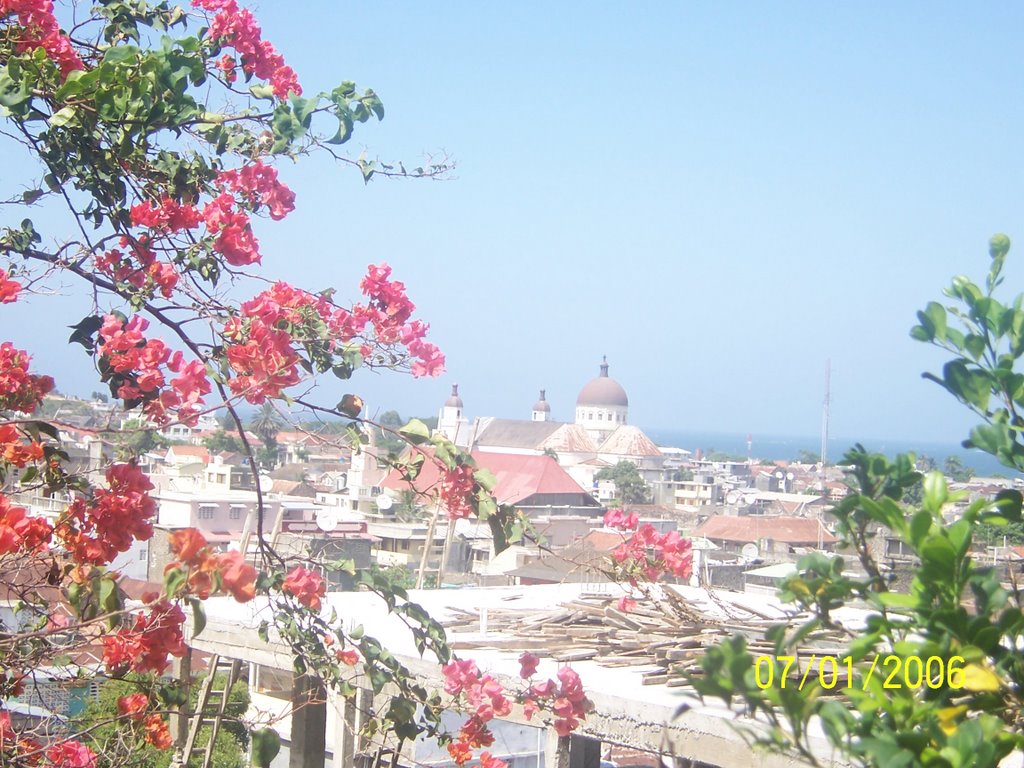
I landed in Port au Prince about a week ago and after spending a day there going back and forth to the airport to find my lost suitcase, I was able to complete my journey to Cap-Haitien which is a small seaside city at the North of Haiti. “Le Cap” is where I will be spending the next few weeks working with and training officers and members of the Mikouti Agro Enterprises—a large group of agricultural producers and helping them build their management and marketing capacity. I am following up on the work of two other volunteers who have assisted the cooperative with developing a business strategy. Makouti’s main focus is on vegetable production, but members also produce processed food products, honey, goat meat, rabbit meat and eggs. Major vegetable crops include tomatoes, cabbage, lettuce, cucumber and eggplant. The project for which I am volunteering aims to increase farmers’incomes by reducing crop losses and increasing production capacity and sales. Posted by Picasa

Wednesday, January 04, 2006

Guatemala in November 2005


In addition to one-on-one instruction, my Spanish immersion program in Guatemala, included learning about the culture and way of life from the artisans and indigenous people of Guatemala.
Photo Credit: Linda Aines

In the APPE Language Schools of Antigua, Guatemala, learning Spanish was made easy for me with the help of Miriam, a capable private teachers that spent some 4 hours of daily instruction and spanish conversation with me.
Photo Credit: Linda Aines

In November 2005, I spent 4 delightful weeks in the Spanish Colonial village of Antigua, Guatemala.
Photo Credit: Linda Aines

Sunday, November 13, 2005

Guatemala, visiting as I learn Spanish

It is November 2005 and I am now in Antigua Guatemala. I am enrolled in a Spanish Instruction and Immersion Program. I am also living with a local family in a home stay situation. I like my Spanish family and I like my School. At my school most students are from the various European countries but more Germans than others. I met one couple from the US and they are from Vermont like me. They are missionaries , here to work with indigenous people and they will be at the school for at least six months as their responsibilities require a high degree of language competence. Another American is a NY city resident who has decided to leave an unrewarding job in NYC and just move here to Antigua for at least six months, perhaps permanently.

We spend every morning, with our respective personal teachers and we work hard at vocabulary, pronunciation verbs expressions etc.. .... My teacher, Miriam,
only speaks a little english so it forces us to speaks Spanish... Afer a big lunch with our respective families, we spend most afternoons in local interactive activities... like tours, visits to meuseums, learning with local artisans. Last Monday, was a tour of the village of Antigua... Thursday, we went to see the famous Pacaya volcano-- a real active one--- about 1.5 hours drive from here...I did not climb to the rim like the younger set, I would not have made it. However those who went to the top said it was very cold with 100 km/hr winds. But they were about one meter away from the lava We also visit local ruins here in Antigua on Fridays and today was not exception with a visit to the ruins of Las Capuchinas, the nuns who settled in Antigua in the 17th Century to educate the local population... Some students are here for a few weeks and some for many months,... some people come back every year and find language immersion a great way to vacation and experience the local culture...

The town of Antigua has about 42,000 people--- It has wonderful old Spanish architecture and cobblestone streets. There is a strong Conservation and Preservation organization that enforces a strict code about keeping the old look in Antigua and they have been effective in making this area a special place that draws tourists from around the world. There are tourist groups coming through Antigua regularly, many from the US and Canada. In response, Antigua has many shops catering to free spending foreigners... Many are jewelry shops --and shops featuring the Guatemanlan artisan goods and textiles. There is Jade mining activity here featuring the Mayan mode of extracting and working the jade so Jade jewelry is a specialty of this region. Antigua is surrounded by three volcanoes. One volcano is semi active but no fire...The beautiful cones make this area a very beautiful place... (I have read that Guatamala has some 33 volcanoes!) There have been earthquakes here that have leveled the town but they keep rebuilding and keeping the old look. it is quite a neat place and even Guatamala city people come here on the weekend to shop and enjoy themselves.

In all, it is not hard being here for four weeks... even when the studies are hard and you don't feel like you can conjugate another irregular verb and you continue to grasp for that spanish vocabulary that is on the tip of your tongue. But the Guatemalans people are wonderful with their smiles, their hospitality and friendship.

Tuesday, April 05, 2005


Enderasha, Kenya: The children are so beautifully open and friendly that you can't help but love them.
Photo Credit: Linda Aines

Tuesday, March 29, 2005


Wherever i went in the village Enderasha, in Kenya, I was the subject of much attention. The children always anxious to be friends and to be in my pictures.
Photo Credit: Linda Aines

The Ark is the name of this "tree hotel" which sits high in Abedare National Park in the Central Highlands of Kenya. It is built like an ark or ship with small berth-like cabins. The meals are first class and the Entertainment is continuous with frequent visits by the many types of animals and which can be viewed from the many decks and glass-enclosed rooms... I only had one day of this "Safari" experience before returning to Endarasha Village and my work with the Farmers Co-operative Society.
Photo Credit: Linda Aines

And during the morning sunrise, i could see the outline of Mount Kenya in the background as an antelope was drinking on the edge of the pond. It was gorgeous! Throughout my short stay at the Abedare National Park and during the many visits by these animals, I kept thinking of Sara, my 4 year old grand niece who so wanted to know if I was going to visit the jungle. Well Sara, this one is for you!
Photo Credit: Linda Aines

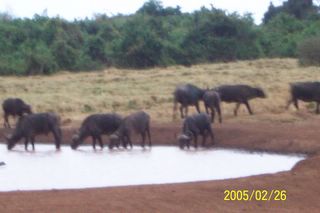
The Buffalos are frequent visitors to the watering hole in this preserve near Nieri Kenya.
Photo Credit: Linda Aines

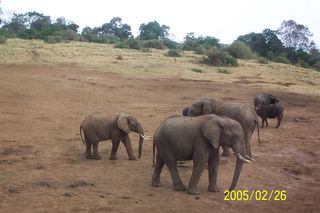
As I spent an overnight stay at a "tree hotel" in the Abedare National Park a few hours from Nairobi, Kenya. I got to view elephants and other animals as they came to the watering hole. Elephants, buffalos, antelopes and other game animals come to this watering hole which is an attraction for wildlife as they come to the muddy pool and saltlick near the hotel. Guests can view the animals from viewing terraces--there is even a ground level photographic hide. It is quite an animated scene as the animals jostle, and sometimes break out in fights especially when new-born calves are around. Throughout the night, if the guests are asleep, a buzzer will sound announcing the animals that come to the hole-- there are special sounds for rinos and leopards which are more rare.
Photo Credit: Linda Aines

Thursday, March 03, 2005

The Central Highlands of Kenya

My Wanderings
Enderasha, Kenya: I have now been here 10 days.... I am one of two white persons in a village of 20,000 in the foothills of Mount Kenya. It is a populated rural agricultural area a few hours from Nairobi, which is very hard to describe. It is quite beautiful, like a patchwork quilt with rolling hills and shade trees. The highlands were at one time all forested but much of it until the land starts rising too steeply has been cleared for agricultural land. There is still the original forest cover in Abedares National Park which is a gated preserve where you can see elephants, buffaloes, antilopes, deers, rinos, leopards, and a variety of smaller animals and birds. I did visit the park last weekend---just had to as there are no animals outside the Park’s electrified fences. I went to the Ark, a “tree hotel” located inside the park, where guest can view some of the animals as they come to the watering hole near the hotel. I found myself along with the 20 or so other US and European tourists, fascinated by these animals. Of course the hotel staff sprinkle some salt near the watering hole every afternoon and it attracts the animals. Hotel guests just watch from the balconies and glassed rooms strategically located to provide an unhampered view of whatever wanders nearby. And they came, like a parade--- first it was the elephants, then the buffaloes. Later there were some sixteen elephants out there hogging the pond and as they cleared out, then came the smaller animals: a warthog, some deers, antilopes. I also saw two janet leopards (very small cats) near the hotel and some other small animals I cannot name. It was hard to go to sleep as the animals hung around for most of the evening. Not to worry, if we go to sleep, the hotel rings a buzzer if some interesting animals come in.

My safari was a short outing, less than 24 hours and now I am back at my assignment, writing a business plan for the Endarasha Farmer’s Co-operative Society. The Society has the biggest buildings in town—a grouping of one and two story brick buildings that house farm input supplies, milk cooling tanks , vehicles that enable this coop to collect and distribute milk for the many small dairy farmers in the Endarasha area. Here I work everyday at the Society’s offices along with Mary, a Peace Corp Volunteer assigned to the Cooperative. At the end of the day, I walk some 150 meters to the grounds of the Endarasha Parish Catholic Church where I eat and sleep. This walk is quite fun as I usually meet all kinds of people from the village---adults and children who are anxious to say hello, if I smile at them. The children are beautiful and just beam if I acknowledge them. I have been given a small cabin on the edge of the garden, to sleep in. My meals are taken in the Rectory, with Father James and Anne, the cook and house manager. I am well fed and in good company. There is a guard on the grounds and he stays in the cabin next to me so I am very safe. This is good!

Saturday, February 26, 2005

Kenya---An amazing landscape

I have now been in Kenya a week. Except for a day in Nairobi, I have spent most of it in the Central Province about 150 km north. I live and work in a village called Endarasha and i am helping the Endarasha Farmers' Dairy Cooperative Society create a business plan that will help them grow in the future. From Nairobi, there a good road up until Nyeri, the administrative headquarters for the Central Province but from Nyeri, there is another 40 minute ride on a road that is full of ruts and stones and it makes for a super hard ride. When I need to get out of Endarasha or go to Nyeri, I ride a small van call a "Menuta" which seats a dozen riders and the bus will not go until it is full so we may have to wait 30 minutes while it waits for more riders... but it is the typical mode of transportation here and almost no one has a car... Nyeri is the trading center for the area which is mostly agricultural. there is extraordinary density of cultivations here in the tightly space farms that grow maize, beans, potatoes, cassava, bananas, sugar cane, millet, squash and melons, tomatoes, citrus fruit, cabbages, and carrots as well as tea, coffee, and macademia nuts... it makes for an extraordinary and beautiful landscape around Endarasha and Nyeri.

I am back in Nyeri today after having spent the night with Mary and a couple of her Peace Corp colleagues. They have been here for more than a year already. Mary is my partner in my project as she has a business degree and has been working at the Cooperative since coming to Kenya. They know their way around the Central Highlands and know many of the residents here. This morning, we caught a ride into Nyeri on the back of a milk truck from the coop where Mary and I are working. We had dust all over us but this didn't phase Mary and her PCV friends, Scott and Stacy, whose dark clothes are now dusty brown and they are on their way to a wedding reception in a town two hours away... and they also have a live goat with them -- Goats or small live animals are normal wedding present to the bride and groom here. As for me, I am shortly going to take a taxi into the big Aberdares National Park, where I will spend the night at the Ark a "tree-hotel" (see ark@form-nt.com) located inside the park and high above the forest canope. Aberdares National Park is near Mt. Kenya. There, I will have a chance of seeing some local animals, perhaps elephants, rinos, etc... This will be the only activity of this sort I will have a chance to do while here as time is short but here's hoping. It will also be nice to treat myself to a bath and shampoo and a dip in the swimming pool before returning to Nyeri and meeting up with Mary and friends for the 40 minute ride back to Endeshara.

Next time, I write on this blog, I will add pictures of this amazing trip to Kenya and of the fabulous landscapes and people I am getting to know.

So long for now..