Wednesday, January 04, 2006

Guatemala in November 2005


In addition to one-on-one instruction, my Spanish immersion program in Guatemala, included learning about the culture and way of life from the artisans and indigenous people of Guatemala.
Photo Credit: Linda Aines

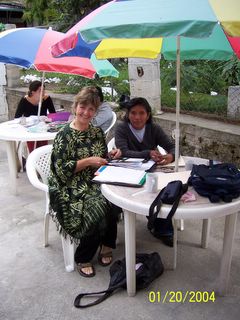
In the APPE Language Schools of Antigua, Guatemala, learning Spanish was made easy for me with the help of Miriam, a capable private teachers that spent some 4 hours of daily instruction and spanish conversation with me.
Photo Credit: Linda Aines

In November 2005, I spent 4 delightful weeks in the Spanish Colonial village of Antigua, Guatemala.
Photo Credit: Linda Aines
Sunday, November 13, 2005

Guatemala, visiting as I learn Spanish

It is November 2005 and I am now in Antigua Guatemala. I am enrolled in a Spanish Instruction and Immersion Program. I am also living with a local family in a home stay situation. I like my Spanish family and I like my School. At my school most students are from the various European countries but more Germans than others. I met one couple from the US and they are from Vermont like me. They are missionaries , here to work with indigenous people and they will be at the school for at least six months as their responsibilities require a high degree of language competence. Another American is a NY city resident who has decided to leave an unrewarding job in NYC and just move here to Antigua for at least six months, perhaps permanently.

We spend every morning, with our respective personal teachers and we work hard at vocabulary, pronunciation verbs expressions etc.. .... My teacher, Miriam,
only speaks a little english so it forces us to speaks Spanish... Afer a big lunch with our respective families, we spend most afternoons in local interactive activities... like tours, visits to meuseums, learning with local artisans. Last Monday, was a tour of the village of Antigua... Thursday, we went to see the famous Pacaya volcano-- a real active one--- about 1.5 hours drive from here...I did not climb to the rim like the younger set, I would not have made it. However those who went to the top said it was very cold with 100 km/hr winds. But they were about one meter away from the lava We also visit local ruins here in Antigua on Fridays and today was not exception with a visit to the ruins of Las Capuchinas, the nuns who settled in Antigua in the 17th Century to educate the local population... Some students are here for a few weeks and some for many months,... some people come back every year and find language immersion a great way to vacation and experience the local culture...

The town of Antigua has about 42,000 people--- It has wonderful old Spanish architecture and cobblestone streets. There is a strong Conservation and Preservation organization that enforces a strict code about keeping the old look in Antigua and they have been effective in making this area a special place that draws tourists from around the world. There are tourist groups coming through Antigua regularly, many from the US and Canada. In response, Antigua has many shops catering to free spending foreigners... Many are jewelry shops --and shops featuring the Guatemanlan artisan goods and textiles. There is Jade mining activity here featuring the Mayan mode of extracting and working the jade so Jade jewelry is a specialty of this region. Antigua is surrounded by three volcanoes. One volcano is semi active but no fire...The beautiful cones make this area a very beautiful place... (I have read that Guatamala has some 33 volcanoes!) There have been earthquakes here that have leveled the town but they keep rebuilding and keeping the old look. it is quite a neat place and even Guatamala city people come here on the weekend to shop and enjoy themselves.

In all, it is not hard being here for four weeks... even when the studies are hard and you don't feel like you can conjugate another irregular verb and you continue to grasp for that spanish vocabulary that is on the tip of your tongue. But the Guatemalans people are wonderful with their smiles, their hospitality and friendship.

Tuesday, April 05, 2005


Enderasha, Kenya: The children are so beautifully open and friendly that you can't help but love them.
Photo Credit: Linda Aines

Tuesday, March 29, 2005


Wherever i went in the village Enderasha, in Kenya, I was the subject of much attention. The children always anxious to be friends and to be in my pictures.
Photo Credit: Linda Aines

The Ark is the name of this "tree hotel" which sits high in Abedare National Park in the Central Highlands of Kenya. It is built like an ark or ship with small berth-like cabins. The meals are first class and the Entertainment is continuous with frequent visits by the many types of animals and which can be viewed from the many decks and glass-enclosed rooms... I only had one day of this "Safari" experience before returning to Endarasha Village and my work with the Farmers Co-operative Society.
Photo Credit: Linda Aines

And during the morning sunrise, i could see the outline of Mount Kenya in the background as an antelope was drinking on the edge of the pond. It was gorgeous! Throughout my short stay at the Abedare National Park and during the many visits by these animals, I kept thinking of Sara, my 4 year old grand niece who so wanted to know if I was going to visit the jungle. Well Sara, this one is for you!
Photo Credit: Linda Aines

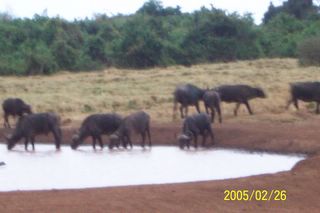
The Buffalos are frequent visitors to the watering hole in this preserve near Nieri Kenya.
Photo Credit: Linda Aines

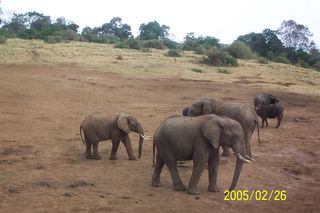
As I spent an overnight stay at a "tree hotel" in the Abedare National Park a few hours from Nairobi, Kenya. I got to view elephants and other animals as they came to the watering hole. Elephants, buffalos, antelopes and other game animals come to this watering hole which is an attraction for wildlife as they come to the muddy pool and saltlick near the hotel. Guests can view the animals from viewing terraces--there is even a ground level photographic hide. It is quite an animated scene as the animals jostle, and sometimes break out in fights especially when new-born calves are around. Throughout the night, if the guests are asleep, a buzzer will sound announcing the animals that come to the hole-- there are special sounds for rinos and leopards which are more rare.
Photo Credit: Linda Aines

Thursday, March 03, 2005

The Central Highlands of Kenya

My Wanderings
Enderasha, Kenya: I have now been here 10 days.... I am one of two white persons in a village of 20,000 in the foothills of Mount Kenya. It is a populated rural agricultural area a few hours from Nairobi, which is very hard to describe. It is quite beautiful, like a patchwork quilt with rolling hills and shade trees. The highlands were at one time all forested but much of it until the land starts rising too steeply has been cleared for agricultural land. There is still the original forest cover in Abedares National Park which is a gated preserve where you can see elephants, buffaloes, antilopes, deers, rinos, leopards, and a variety of smaller animals and birds. I did visit the park last weekend---just had to as there are no animals outside the Park’s electrified fences. I went to the Ark, a “tree hotel” located inside the park, where guest can view some of the animals as they come to the watering hole near the hotel. I found myself along with the 20 or so other US and European tourists, fascinated by these animals. Of course the hotel staff sprinkle some salt near the watering hole every afternoon and it attracts the animals. Hotel guests just watch from the balconies and glassed rooms strategically located to provide an unhampered view of whatever wanders nearby. And they came, like a parade--- first it was the elephants, then the buffaloes. Later there were some sixteen elephants out there hogging the pond and as they cleared out, then came the smaller animals: a warthog, some deers, antilopes. I also saw two janet leopards (very small cats) near the hotel and some other small animals I cannot name. It was hard to go to sleep as the animals hung around for most of the evening. Not to worry, if we go to sleep, the hotel rings a buzzer if some interesting animals come in.

My safari was a short outing, less than 24 hours and now I am back at my assignment, writing a business plan for the Endarasha Farmer’s Co-operative Society. The Society has the biggest buildings in town—a grouping of one and two story brick buildings that house farm input supplies, milk cooling tanks , vehicles that enable this coop to collect and distribute milk for the many small dairy farmers in the Endarasha area. Here I work everyday at the Society’s offices along with Mary, a Peace Corp Volunteer assigned to the Cooperative. At the end of the day, I walk some 150 meters to the grounds of the Endarasha Parish Catholic Church where I eat and sleep. This walk is quite fun as I usually meet all kinds of people from the village---adults and children who are anxious to say hello, if I smile at them. The children are beautiful and just beam if I acknowledge them. I have been given a small cabin on the edge of the garden, to sleep in. My meals are taken in the Rectory, with Father James and Anne, the cook and house manager. I am well fed and in good company. There is a guard on the grounds and he stays in the cabin next to me so I am very safe. This is good!

Saturday, February 26, 2005

Kenya---An amazing landscape

I have now been in Kenya a week. Except for a day in Nairobi, I have spent most of it in the Central Province about 150 km north. I live and work in a village called Endarasha and i am helping the Endarasha Farmers' Dairy Cooperative Society create a business plan that will help them grow in the future. From Nairobi, there a good road up until Nyeri, the administrative headquarters for the Central Province but from Nyeri, there is another 40 minute ride on a road that is full of ruts and stones and it makes for a super hard ride. When I need to get out of Endarasha or go to Nyeri, I ride a small van call a "Menuta" which seats a dozen riders and the bus will not go until it is full so we may have to wait 30 minutes while it waits for more riders... but it is the typical mode of transportation here and almost no one has a car... Nyeri is the trading center for the area which is mostly agricultural. there is extraordinary density of cultivations here in the tightly space farms that grow maize, beans, potatoes, cassava, bananas, sugar cane, millet, squash and melons, tomatoes, citrus fruit, cabbages, and carrots as well as tea, coffee, and macademia nuts... it makes for an extraordinary and beautiful landscape around Endarasha and Nyeri.

I am back in Nyeri today after having spent the night with Mary and a couple of her Peace Corp colleagues. They have been here for more than a year already. Mary is my partner in my project as she has a business degree and has been working at the Cooperative since coming to Kenya. They know their way around the Central Highlands and know many of the residents here. This morning, we caught a ride into Nyeri on the back of a milk truck from the coop where Mary and I are working. We had dust all over us but this didn't phase Mary and her PCV friends, Scott and Stacy, whose dark clothes are now dusty brown and they are on their way to a wedding reception in a town two hours away... and they also have a live goat with them -- Goats or small live animals are normal wedding present to the bride and groom here. As for me, I am shortly going to take a taxi into the big Aberdares National Park, where I will spend the night at the Ark a "tree-hotel" (see ark@form-nt.com) located inside the park and high above the forest canope. Aberdares National Park is near Mt. Kenya. There, I will have a chance of seeing some local animals, perhaps elephants, rinos, etc... This will be the only activity of this sort I will have a chance to do while here as time is short but here's hoping. It will also be nice to treat myself to a bath and shampoo and a dip in the swimming pool before returning to Nyeri and meeting up with Mary and friends for the 40 minute ride back to Endeshara.

Next time, I write on this blog, I will add pictures of this amazing trip to Kenya and of the fabulous landscapes and people I am getting to know.

So long for now..

Wednesday, September 01, 2004

The Sounds of Kabul

Being here has been very interesting. I wake up at 4 a.m. with the singing ---It's the Call to Prayer from the mosques. There are many mosques scattered around the city and the clerics go into the minaret of their respective mosques and sing their prayers. The singings from all the mosques blend and just come wafting through every window. It is very pleasant to listen. They do it again at 5 p.m. and again at 7 p.m. Each time it happens, I want to just stop and listen for a while. It seems that the "callers" all have great voices. It is also great that in Afghanistan, they still do the Call to Prayer by singing naturally. In some countries, they have tried loudspeakers and I noticed that in Bosnia, they would play very bad tape recordings over a loudspeaker. It sounded like a scratched record. Here in Afghanistan, it is indeed a beautiful sound....

We have 3 -4 young male employees at the CNFA office who work as program assistants, drivers or guards. They don't make a big deal about their religion. They are very nice young men who want to have a good job, have the freedom to worship, raise a family in relative peace. One reporter summed it up: "The Taliban's strict approach to Islam forced every Afghan to be a radical Muslim. For the six years the militia ruled the country, men had to go to the mosque seven times a day and grow long beards -- or face public beatings or even jail. Women had to quit their jobs, cover their faces and their entire bodies with burqas, and leave their houses only with their husbands or fathers. But now that the hard-line movement's strong grip on Afghan society has been released -- even in the countryside, where support for it was strongest -- some people are not sure they want to be Muslim at all. Most Afghans say they consider themselves devout Muslims, but few pray five times a day, as the Koran instructs. " (Anna Badkhen, SF Chronicle Staff Writer, Jan. 2002) It seems that the people here are no longer as united by Islam as they are by the wish to live in a free state that has no more wars.

I am getting to the end of my assignment here. In a way I hate to leave this place. I will miss the singing, the people I've met, the sounds and sites of the streets of Kabul. There are so many things undiscovered. The Bomb this week forced everyone to restrict their movements. The security alerts system here warn that there will be more suicide bombings as we get closer to Mr. Karsai's election. I forgot to ask if anyone is running against him---haven't heard that there is. It seems that if someone has something to say, they ought to run for office but it doesn't work that way here yet. Meanwhile everyone is going about their business trying not to give opportunity to be a target.

This morning, I went to Kabul University and made a presentation to the College of Agriculture faculty. I spoke about Rural Development, and Extension systems. We had a very nice reception from the Dean and the Ag faculty -many speak English---and they are so interested in improving services to farmers. There are a few women enrolled in the College but none came to my class. It is great to see girls go to school here now. 70% of this country is still illiterate, but last week was the beginning of the school year and the streets are full of girls and boy going to school. At the University, one professor told me that when women marry here, there usually is no courtship. Marriages are arranged. The boy's parents have to pay for all expenses of the wedding and presents for everyone. It can be an elaborate affair costing up to $5000 or more. How any parent in this country-- where the average monthly salary is under $100-- can afford a marriage is a mystery! Well so long Kabul, it has been great....


Photo Credit: Linda Aines

Sunday, August 29, 2004

The reality of Afghanistan

It is very easy to get complacent here when day after day you have settled into a routine. You get up and have breakfast along with the other patrons of the guesthouse, go to work at the office or out around Kabul to various meetings, then back to the guesthouse, dinner, and then to bed after doing your email. Although the streets of Kabul are full of delightful scenes that are new to my eyes, security dictates that you don't go out and about without caution. The Kabul streets are so normal and really, there is very little sign of the International Forces here, except an occasional sighting of an army truck or a jet overhead. I had really started to feel like I could go out (always with caution,) and chat with merchants and people on the street.

It happened today.... KaBoom! A big explosion around 5:30 pm. It shook our guesthouse so much that I thought we had been hit. Things flew off the shelves and I thought the windows had shattered but they didn't. I looked outside and no sign of smoke---only the other guests venturing outside their room to find out what happened. But there were obvious signs of activity outside out compound wall. The television was on and it seemed that within 20 minutes, an announcement was made on BBC that a huge explosion had happened in the Center of Kabul-- near the US Embassy and other International Organizations. Well no sweat, this is miles from here. Just the same we didn't go outside of our compound and all ate dinner at our guest house tonight. We were only too glad to stay close to home, swap stories with the other guests. A later newscast and the hotel gossip brought it all closer..... The bomb, likely a car or truck bomb, detonated about a block from our hotel. It was targeted at an American security company. Some seven people have been killed, four of them Americans. It is so sad! We had received alerts or warnings today of potential violence or suicide bombings in the Kabul area.

It seems that accellerating violence is expected here over the next month due to Karsai's pending re-election or rather first time election. There are some who do not want to see him elected. They see him as a puppet of the U.S. Yesterday, in an Embassy meeting, I heard this on the security situation: "Here 99% of the people are really good and glad to have us here. But it is the one percent that we really have to worry about." It has also been my impression here that most people here are glad for having had this year of relative normalcy in Afghanistan. The past year has helped the Economy grow, GDP was up a whopping 20% in 2003---investments are being made in the country. There is money here and people who are willing to invest in new ventures and get in on the start of a period of rapid expansion.

I wish I could stay and help it happen, but I am a big chicken. I will be on a plane heading home by Friday of this week. Enjoy the pictures... L


Here is a picture of my guesthouse in Kabul. It is quite pleasant inside these compound guesthouses. There are lot of flowers including roses and geraniums; and lots of people to water 24 hours a day.

Photo Credit: Linda Aines
Kabul, Afghanistan...One night, had a great dinner with Fitsum, Raphy and Richard, who like me, work here. We dined in a nomad tent outside their guest house. The tent was all fixed up with the traditional Afghan carpets and cushions. And what food!

Photo Credit: Linda Aines

Friday, August 27, 2004

In Kabul, everyone is a Merchant. Posted by Hello
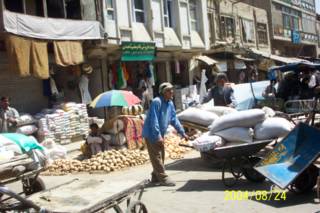
The Wholesale Market in Kabul, where everything is bought and sold.... Posted by Hello
The Kabul streets are full of life. There are cars, horses, mules, people with all types of different dress depending on their origin or their tribe. Posted by Hello

A day in Kabul

I have now been here more than 10 days and life seems to take on different hues and colors. I expected to find more here than expected and have not been disappointed. There are the delightful moments when someone on the street hands you a piece of merchandise to try like a pomegranate or the new almonds from this year’s and tries to get to know you. Every time someone smiles a welcome gesture to you, you realize this isn’t just the armpit of the world. These are people who love their land and their life here. There has been one war or something like it for 20 years and everybody looks forward to some normalcy—that was how they allow the Taliban to take over as they calmed things down and got things under control at first. Then corruption set in and it got bad. What remains here is some typical disputes between tribal leaders. But these tribal leaders or warlords will eventually be part of the ongoing solution here as they are stakeholders..

Our driver took me into the ancient part of Kabul yesterday, where all the wholesaling takes place. This must be a place that hasn’t changed much in a thousand years. Street after street of traders selling flour, nuts, fruits, imported goods. Most of the exhibited stuff is in bulk on the outside walls of the structures – jutting out in the streets and you can wind you way around these very narrow streets --- it goes on and on. Some streets are all the Almond and Postachio dealers, other streets are the flour dealers. And of course the streets are named after the dealers who do business there. Such as Flour Street, Chicken St, etc.. There are streets where meat just hangs on hooks all day with flies, etc.. just buzz about. .It was quite picturesque (and smelly!) and I tried to take as many photos as I could. As I stood out enough , even with my large silk scarf wrapped around my shoulders and head--and walking slightly behind my driver, I still drew attention . But with my camera at my waist, I just snapped away in all directions and got some great pictures anyways. Richard, my Chief of Mission, had requested we not go to this section of town when I first arrived here but by this week, there are no more restrictions on any areas in Kabul. Things are very quiet everywhere. Of course, I purchased a kilo of pistachios and almonds to bring back home with me. But it was fun interacting with the merchants—like the Armenians, they like to have their pictures taken. I also met a little boy , about six years old, who was selling silk shopping bags, his mother makes for him to sell to shoppers for 10 afs (about 20 cents.) I bought one of course for the chance to talk to him a little. And hope to have a chance to go do some more shopping in the coming days .

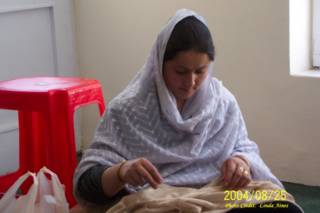
Today and tomorrow, I am interacting with more women than I have been able to since coming here. I plan to do a focus group with local women tomorrow and have been preparing a questionnaire about how they shop and cook with flour at home. The hotel has arranged for the women to come into the conference room to meet with me. That should be so interesting.... Some women came to the office today. They had been commissioned to make curtains for our office and came in to hang them up. They were very happily chatting about and when they saw me were very anxious to interact. One said in broken English, “we are Pashtoon, and working for Relief International, we are happy to meet you!” They were dressed in long dresses or suits, with beautiful large scarves to match that covered their hair and shoulders. They also wore georgeous gold jewelry that I would like to find the source for. They wear makeup and are very beautiful. I have been amazed at how even the older women are very attractive with clear green or goldish brown eyes. We also have another woman who works at our office. She cleans and she cooks lunch for all of us and the guards. She is 23 and has a child that is about 11 years old. Her husband disappeared a few years ago and may have been taken by the Taliban. His whereabouts are unknown. It is common for women to be married at 12 or 14 years old here. We also have a few very nice young men who work for us as guards and drivers. I questioned them about the custom of marrying young and they don’t think anything of it. It is part of the culture here. Although my driver who just had a 3rd daughter a few weeks ago, says he married his wife when she was 20... also not all that unusual.

Tonight, our crew was invited to the home of an international couple who work here. Raphy is a Swiss business consultant who works for a well known consulting firm in Kabul that has furnished us with a lot of our ag research data and his wife Fitsum works for Unicef and has had a very successful program here with the food nutrition and salt iodization programs here. This successful program has formed the basis for our plan to have a flour fortification mill in Afghanistan. Since only two of us CNFA consultants were Kabul today, we went over and they entertained us in a Nomad tent on the lawn of their guest house. Inside the large woolen tent, were Afghan colorful lights and the floor was filled with carpets and cushions. We were served dinner and drinks out there. This is very much like the way the Nomads live only perhaps not so elegant. We had nice wine, tea, and Macadamia nuts, to go with it.

Wish all my days here would be so pleasant. It was fun.... but have to get some sleep now. Be well, Linda.